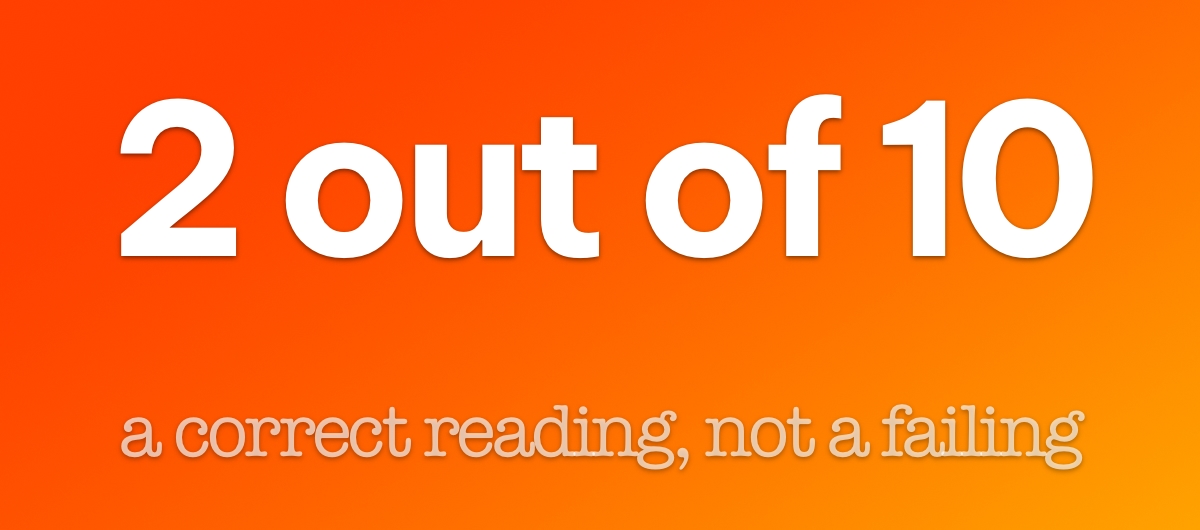
A contrarian proposition from a bad week: if a punishing enough month has not flattened you, the problem is not your resilience—it is that your instruments have stopped reading. Collapse, past a certain load, is the correct answer, not the failure.
Where the 2 came from
The man two doors down starts hammering at six. Not the house—the cement mixer, which fills overnight with dried concrete and has to be beaten clean each morning with what sounds like a mallet built for cathedral bells. That is my alarm now. I moved here, into my wife’s small house in Đà Lạt, to get away from noise, which in hindsight is like changing seats on a plane to get further from the engines. My mood this week has sat at a two out of ten. I am telling you that first because the rest of this is going to make the number make sense, and because pretending otherwise is a game I no longer have the energy to play.
November began with a move. Out of the Osaka complex, into my wife’s place, and three weeks of turning the mess one person had lived in into a home two people could share. That meant furniture. Vietnamese furniture is not the flat-packed pine of my Adelaide years; it is solid timber, built to outlast the house, and roughly the weight of a small car. I have a back with decades of documented damage, and I spent a weekend dragging wardrobes across tiles with it. The home is lovely now. My wife loves it, I love it, her friend came and loved it too. And my spine has been presenting its invoice ever since.
The noise, though, came with me. I left Osaka to escape the karaoke and the all-day construction, and the universe, which has a sense of humour I am no longer sure I share, promptly installed a brand-new house build two doors down and a karaoke habit on the lane that had barely existed before we arrived. Đà Lạt does not do Sundays. The work starts at sunrise and runs to dark, seven days a week, and then a man who believes he is 2026’s answer to Dean Martin takes the microphone and the volume dial to eleven and holds both well past ten at night. There is no remission. For a body that has spent a lifetime paying for this sort of thing, no remission matters more than it sounds.
The week that earned it
Then came the week that earned the two. On Monday my doctor asked me to come in, and told me my last bloods had thrown up cancer markers—some in the chest, which did not frighten me, and some in the colon, which did, because colon cancer is what killed my mum. Tuesday: the first flight to Ho Chi Minh City. Wednesday: a colonoscopy and a CT scan, preceded by the preparation they make you drink, which in my case did not fully work, so that the procedure became a flood the nursing staff were still holding my clothes clear of while I came round. Long COVID took my sense of smell two years ago, so I went to lunch with my lawyer afterwards with no idea how bad I was. Small mercies arrive in strange packaging. The results were clear. I wept with the relief of it on the flight home, where my wife was waiting at the airport as a surprise I had not earned and was grateful for anyway.
Thursday saw my medical practice in Adelaide send me my medical records, everything recorded by the Australian medical system since my return in 1999. I sent my doctor here in Đà Lạt a synopsis of the relevant bits.
The all-clear on Wednesday. My gut has not settled since, and the days after have been spent never more than a dozen paces from a toilet, wearing my wife’s sanitary pads because the alternative is worse, and learning at sixty-seven, from the inside, exactly what half the species has been putting up with uncomplainingly since the beginning. The doctor I saw on the Friday was not the warm one I was used to. She had read my history—the back, the headaches, the long COVID, the long and stubborn list—and something in her went careful, the way people do when they realise the patient in front of them will not be a quick appointment. I do not blame her. I have become a complicated file.
Reading my own press
Underneath the medical theatre, two quieter things were doing the real damage. I have spent the month finishing MISREAD, my book on being diagnosed autistic and ADHD late in life, and this week I was editing the chapter on grief, which meant sitting for hours inside the grief I had written it from: the friendships I let burn out, the two old friends who no longer answer. And I have been rereading, half a dozen times over, the submission my co-author and I drafted to the Department of Veterans’ Affairs, the one that lays out in a professional’s plain words just how disabled I am. You are never meant to read your own press. I read mine until I believed it.
The correct answer to the sum
Here is the thing I know as a psychologist and keep forgetting as a man. A body and a mind do not fold because they are weak. They fold because they have been asked to carry too much for too long, and the folding is the correct answer to that sum. There is even a name for the running cost of staying braced against the world—allostatic load, the wear a system takes from never being allowed to stand down—and researchers have spent years adding up its bill in cortisol and blood pressure and inflammation (Juster, McEwen & Lupien, 2010). My month delivered about a quarter’s worth of that load in four weeks. The exhaustion is not a flaw in me. It is an accurate reading. If a month like that had left me sprightly, the instrument would be the thing that was broken.
The unreliable judge
The submission is a different trap, and I nearly walked straight into it. That document was built to win. It foregrounds every deficit and leaves the coping in the margins, because that is what the Department needs to see to say ‘yes’. It is a closing argument, not a biography. Reading it as the truth of who I am is like reading the prosecution’s summary and mistaking it for your own life story. And the mind doing that reading, this week, is the same mind that went out on Saturday morning, took a set of photographs, and declared every one of them worthless filler—while knowing, from thirty years of doing this, that in five days I may look again and find two I love. The judge is not reliable today. He has said so himself. I am not going to let the two-out-of-ten version of me write my character reference, or decide, on the strength of one bad Saturday, that a lifetime of friendships fell away because I am broken, rather than because people drift, and lives fill up, and I moved to the other side of the world.
What the rage looks like
So, what does raging against the dying of the light actually look like, at sixty-seven, flattened? Not grand. It looks like taking the photographs anyway. It looks like editing one more page of the grief chapter. It looks like getting a mate in to drill holes in a new wall, so the pictures go up and a house becomes a home. And it looks like this—writing the month down, because writing is how I have always turned my life into something I can carry. My old journals do it on every page: the feeling first, and then, a few lines later, perhaps it is this, or maybe I will try that. There turns out to be a reason it works. Putting a feeling into words measurably quietens the brain’s alarm system (Lieberman et al., 2007), which means the journalling instinct I have had since I was a teenager writing miserable poetry was sound neurology the whole time. The writing is the proof that the grief has not swallowed me. A man who is going under does not stop to describe the water.
Tomorrow, at six
I am not going to pretend I can see the hope from here, because I can’t. But I have lived in these mountains long enough to know the Đà Lạt fog. It comes down most afternoons by four and hides the hills completely, and in all that time I have never once known it to take the hills with it when it lifts. I cannot see them today. Tomorrow the mallet will start at six, and I will make a coffee, and edit another page of a book about grief, and that—not optimism, which I do not have in stock this week, but the small stubborn doing of the next thing—is what the rage looks like when the light is low. It is not much. It has, so far, been enough.
References
Juster, R.-P., McEwen, B. S., & Lupien, S. J. (2010). Allostatic load biomarkers of chronic stress and impact on health and cognition. Neuroscience and Biobehavioral Reviews, 35(1), 2–16. https://doi.org/10.1016/j.neubiorev.2009.10.002
Lieberman, M. D., Eisenberger, N. I., Crockett, M. J., Tom, S. M., Pfeifer, J. H., & Way, B. M. (2007). Putting feelings into words: Affect labeling disrupts amygdala activity in response to affective stimuli. Psychological Science, 18(5), 421–428. https://doi.org/10.1111/j.1467-9280.2007.01916.x
Leave a Reply