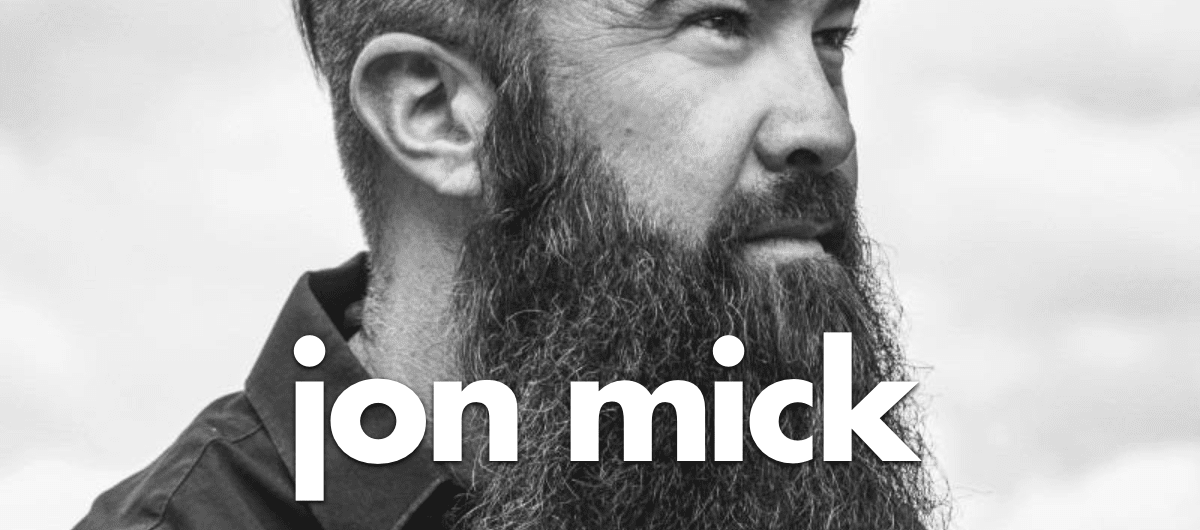
Jon Mick is 45, lives in Austin, Texas, and has published his brain MRI on the internet.
Not a scan. Not a summary. The full volumetric data—seven analysis pipelines, lobule-by-lobule cerebellar parcellation, thalamic nuclei measurements, cortical thickness maps, and biological age estimates for individual brain structures—all laid out on a website alongside his personality profile, his attachment style, his political orientation, his core wounds, his wife’s attachment style, and 63,000 of his text messages organised into a searchable database.
He calls it jonmick.ai. It is, depending on your disposition, either one of the most ambitious personal AI infrastructure projects currently running on the internet, or one of the most comprehensively documented acts of self-exposure in the history of the quantified-self movement. Possibly both.
The architecture
Mick was diagnosed AuDHD at 43—ADHD-Inattentive combined with autism and intellectual giftedness. What he calls twice-exceptional, or 2e. The diagnosis arrived after four decades of compensating hard enough that nobody noticed the compensation. A pattern that will be wearily familiar to anyone who’s received a late neurodivergent diagnosis and immediately understood why every productivity system they’d ever tried had eventually collapsed under its own good intentions.
His response to the diagnosis was not therapy, although he does that too. His response was to build infrastructure. A Supabase database with more than ninety tables. A ‘Life Model’ comprising fifty-two structured tables of psychometric data, cognitive profile information, energy patterns, decision-making frameworks, and relational maps. Automated pipelines syncing his Whoop biometric data every forty-five minutes, his text messages every hour, his audio transcripts through Deepgram. A Telegram bot that ingests documents, classifies them using Claude Vision, and routes them to the correct life area. A phone number you can call to speak with an AI that has access to his writing, his brain data, his genetics, and his neurofeedback progress.
The technical stack is sensible—Supabase, Vercel, Claude, Python serverless functions—and the execution is genuinely impressive for a solo founder running a full-time product management job alongside the build. This is not a weekend project with a landing page and a waitlist. This is a working system.
The thesis
Mick’s central argument is one I find clinically interesting because it reframes a familiar problem from the infrastructure side rather than the therapeutic side. He argues that working memory fragility—his term, and a good one—is the core architectural feature of ADHD cognition, not a deficit layered on top of otherwise normal processing. The ADHD brain’s procedural memory is intact. Its working memory is impaired. This creates a specific bottleneck, not a global deficit.
From this, he derives what he calls the WMF framework. External scaffolding for ADHD cognition is not a crutch or a convenience. It is prosthetic necessity—completing an architecture that was designed for a different operating environment. The seven hundred browser tabs are not a sign of disorder. They are external working memory doing exactly what it should.
I’ve spent enough years working with neurodivergent clients, and enough years being one, to recognise the emotional architecture underneath this argument. The relief of reframing deficit as design. The intellectual satisfaction of replacing ‘I should try harder’ with ‘I need better tools.’ The quiet fury at decades of advice that assumed the problem was motivation when the problem was infrastructure.
The reframe is valid. The research support is there—Mick cites sixty-seven sources in his published paper on ADHD cognitive architecture, drawing on fMRI, QEEG, evolutionary psychology, and cognitive performance data. As theoretical frameworks go, WMF is well-constructed and clinically useful.
The exposure
And then there is the other thing.
Mick has published, on a publicly indexed website, a vulnerability profile so comprehensive that it would make a clinical intake form look discreet. His baseline emotion is fear. His core wounds are rejection and feeling unseen. His attachment style is anxious. His wife’s attachment style is fearful-avoidant. His 0th percentile orderliness. His worth-through-fixing cycle, which he’s named Error 404 with the kind of self-aware gallows humour that suggests he understands exactly what he’s doing.
This is radical transparency as philosophy, and I respect the courage of it. I also recognise it as a permanently indexed vulnerability map. Every future employer, business partner, romantic interest, and adversary now has access to a document that identifies his core wounds, his triggers, his defensive patterns, and the precise emotional architecture that governs his responses under stress. He’s published the user manual for manipulating him, alongside the user manual for supporting him, and is trusting the internet to choose the right one.
That is either extraordinary faith in human nature or a calculated bet that the signal value of radical openness outweighs the exploitation risk. Given that his baseline emotion is fear, the decision to publish it anyway tells you something important about his character.
The brain data
The MRI analysis page is the most technically ambitious section. Mick obtained a research-grade structural MRI through a University of Texas study and ran it through seven volBrain analysis pipelines. The headline finding is a rightward cerebellar asymmetry—his right cerebellar Lobule VI is twenty-one per cent larger than the left, outside the normative range.
The interpretation he offers is careful but occasionally pushes beyond what structural volumetrics can support. Describing brain regions as ‘tired’ or ‘showing wear’ is metaphorical shorthand for age-adjusted volume differences, not a clinical finding about fatigue or degradation. The left hemisphere aging pattern he describes—language regions appearing seven to ten years older than chronological age—is interesting but requires longitudinal data to distinguish developmental trajectory from accumulated demand. One scan is a snapshot, not a story.
That said, the important negatives are genuinely informative. Normal prefrontal cortex. Normal thalamic nuclei. Normal basal ganglia. Normal hippocampus. Normal overall brain age. The structural foundation is sound, and the asymmetries are consistent with a brain that has organised itself differently rather than one that is deteriorating. For a personal self-knowledge project, this is remarkably thorough work.
What this means for neurodivergent adults
Here is where I stop assessing Jon Mick’s project and start thinking about what it implies for the rest of us.
The persistent context problem is real. Every neurodivergent person who has ever started a conversation with an AI, built something useful over ninety minutes, and then watched the context evaporate when the session ended understands the problem Mick is solving. The AI doesn’t remember you. It doesn’t know your patterns. It doesn’t understand that when you say ‘I’m fine’ you mean ‘I’m in executive function shutdown and need scaffolding, not reassurance.’ Mick’s Life Model approach—structured, persistent, self-owned context that gets fed to AI at runtime—is an engineering solution to a problem that the major AI platforms have been slow to address.
The data ownership question matters. Mick’s data lives in his own Supabase database. It is not locked inside a platform that could change its terms, deprecate its memory features, or sell the most intimate details of his cognitive architecture to advertisers. For neurodivergent adults whose self-knowledge has been hard-won through decades of misdiagnosis and masking, the idea that your carefully built understanding of yourself should be portable, exportable, and owned by you is not a technical preference. It is a boundary.
The productisation gap is the honest risk. Mick’s system is exquisitely calibrated to one mind. Ninety tables of structured self-knowledge built over three years of obsessive documentation and coached self-discovery. The question every quantified-self project must eventually answer is whether the architecture generalises or whether the magic was always in the specific person doing the building. Mick’s company, AIs & Shine, exists to answer that question. The answer is not yet clear.
The uncomfortable recognition
I will be honest about what caught me in this project. It was not the technical architecture, although that is impressive. It was not the research paper, although that is well-constructed. It was the phrase ‘worth amnesia.’
Mick describes waking up each morning and rebuilding his sense of self from near-zero. Evidence of his competence and progress does not persist through daily consciousness resets. He has built an entire system—a database, a website, an AI infrastructure—to solve the problem of forgetting, each morning, that he matters.
If you have spent decades compensating for a brain that works differently, masking hard enough that nobody noticed the cost, and arriving at a late diagnosis that simultaneously explained everything and invalidated every piece of advice you’d ever received about trying harder—you will recognise that architecture. Not the database. The emotional architecture underneath it. The building as proof of worth. The documentation as defence against forgetting. The system as scaffolding for a self that does not trust its own continuity.
Jon Mick has built his own brain on the internet. The interesting question is not whether it works. It clearly does. The interesting question is what it tells us about what was missing.
Find out more at johnmick.ai and Jon’s Substack.
Note: Jon’s downloadable profile (jonmick.ai/data/jon-mick-profile.md) is a plain-text markdown file designed to be pasted directly into any AI chat for instant context—not a traditional web page. If your browser displays raw text when you click through, that’s by design.
Leave a Reply